Ghost Molecules? A Lennard-Jones Stress Test for Neural Potentials
- Home
/Ghost Molecules? A Lennard-Jones Stress Test for Neural Potentials


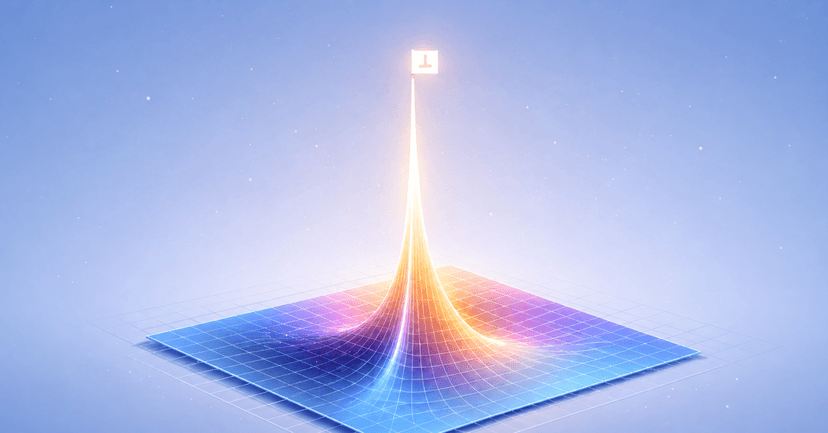
If a learned potential makes short-range repulsion too cheap, an optimizer can accept overlapping atoms. That is the "ghost molecule" failure: not a rendering glitch, but bad extrapolation near the steepest part of the energy curve. This post covers a deliberately small test: a one-dimensional Lennard-Jones dimer. It is not a drug-discovery benchmark, a quantum chemistry result, or a direct test of the Pauli exclusion principle. The goal is narrower: check whether a model that looks good on the observed shoulder still respects the repulsive core.
The ground truth is analytic:
with derivative labels:
The "Soft Wall" Problem
Use the reciprocal coordinate . As atoms approach, the leading repulsive term grows like . A generic MLP trained on a finite interval has no built-in reason to continue that growth outside the samples. It can fit the attractive well and the first part of the shoulder, then extend into the core with a wall that is smooth, finite, and too soft.
This is not a universal-approximation complaint. On a covered training interval, a large enough model with enough data can fit the curve. The failure mode starts when optimization walks past the edge of the training distribution.
What Changed
The stable ZeroProofML variant keeps a deep backbone, but uses an improper rational output head. In this experiment, ZeroProofML provides the rational-head inductive bias and stable parameterization; the Lennard-Jones oracle supplies the target energies and derivatives.
For the LJ preset, and . The denominator is parameterized to stay positive, and the leading numerator coefficient is positive. The feature is scaled reciprocal distance:
This does not hard-code Lennard-Jones, and it does not guarantee the true asymptote. It gives the dangerous direction a better default: positive super-linear growth instead of a saturating tail or weak ramp.
The Test
The stress test used the following setup:
| Item | Setting |
|---|---|
| Seeds | 10 |
| LJ parameters | |
| Training range | |
| Core test range | |
| Training signal | energy + derivative match |
The core metric is log10_energy_mae_core on samples with :
| Model | Core log-error |
|---|---|
| ZeroProofML stable improper head | 1.332 ± 0.399 |
| Deep MLP baseline | 4.842 ± 0.0505 |
Takeaway
Interpolation scores can hide weak extrapolation near singular or near-singular limits. For this LJ dimer benchmark, a positive improper rational head gives short-range wall extrapolation a better shape than a smooth MLP baseline. Broader molecular-simulation claims still need separate validation: multi-atom systems, force-field datasets, integration stability, conservation behavior, and thermodynamic tests.
Join our newsletter!
Enter your email to receive our latest newsletter.
Don't worry, we don't spam



Related Articles

ZeroProofML 0.6.0: Strict Inference Hardening
ZeroProofML 0.6.0 hardens the strict-inference contract: stable fault/semantic provenance, fail-closed non-finite routing, explicit simplification modes, and named projective gauge conventions.
ZeroProofML 0.5.1: Strict Inference You Can Audit
ZeroProofML 0.5.1 makes strict rational inference inspectable across export, validation, and deployment handoff.

Ghost Molecules? A Lennard-Jones Stress Test for Neural Potentials
A controlled Lennard-Jones dimer test shows where smooth neural potentials can look accurate yet extrapolate too softly in the repulsive core.